Why BolivianBeef
The ranching life isn't being outcompeted. It's being priced out.
In Bolivia and around the world, families who have raised cattle for generations are doing the same work for thinner and thinner margins. The knowledge is still there. The land is still there. What's missing is a way to turn good practice into a better price.
What a small ranch has, and what the market now pays for.
Both columns below describe the same rancher, on the same day, doing the same work.
- —Generations of knowledge about this land, this herd and this weather.
- —Daily decisions — where to graze, when to move, which animal to treat — that nobody writes down.
- —A reputation that reaches as far as the neighbours and no further.
- —A price set by whichever buyer turns up at the gate.
- +Practice that is documented, dated and open to inspection.
- +Animals that can be traced back to the pasture that raised them.
- +Land stewardship someone outside the family has verified.
- +A track record a lender or a certifier can actually check.
Only one of those columns is legible to the people holding the money.
The scale
This is not a Bolivian problem with a Bolivian cause.
The same squeeze shows up wherever small producers meet big markets: it is simply harsher where there is less credit, less infrastructure and less margin for a bad season.
farms worldwide. Most of the world's farmers are smallholders working less than two hectares, and in Our World in Data's words, "these farmers are some of the poorest." Small plots and low labour productivity make it hard to raise incomes and escape poverty at all.2
of U.S. farms are small family operations, and those households "typically rely on off-farm sources for the majority of their household income." Even with machinery, subsidies and deep rural credit markets, the farm alone does not cover the family.1
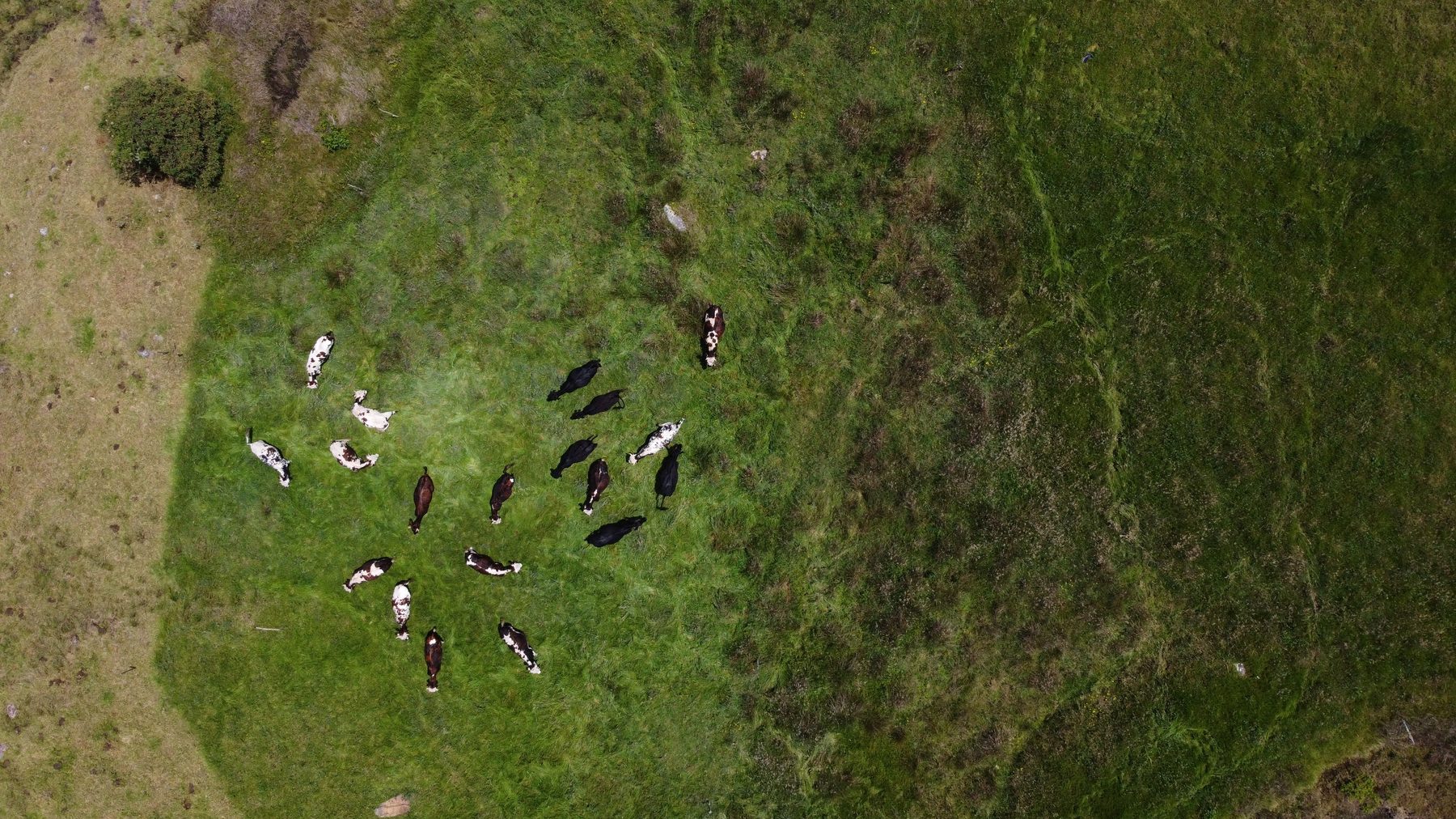
Real pasture, real herds: what we're building for
The second squeeze
Climate pressure is tightening the same screw.
The IPCC's Sixth Assessment Report finds livestock systems across the Andes under direct pressure from rising temperatures, shrinking pasture and disrupted water supply, with glacier retreat affecting Andean pastoralists specifically.3
For a large operation, a harder climate is a line item: more feed, deeper wells, a hedge. For a family running a small herd, it is the difference between a year that works and a year that doesn't. The families with the least capacity to absorb the shock are the ones standing closest to it, and the practices that would help most (rotational grazing, pasture recovery, better water management) are exactly the ones that rarely reach them.
And in Bolivia
The need is recognised. What's missing is a way for a single family to show where they stand.
The World Bank reports that more than 100,000 Bolivian producers are working to raise incomes, reach new markets and build climate resilience through the Rural Alliances Project, with further programmes reaching 800 rural associations and 1,900 producer groups.4
Programmes at that scale prove the problem is real and that institutions are willing to fund the answer. But a programme measures a region. A buyer, a lender or a certifier has to make a decision about one ranch, one herd, one family, and right now there is almost nothing for them to look at. Here is what we built in response.
What we built
Teach the practice. Record the proof. Turn the record into leverage.
BolivianBeef is a mobile platform for small ranching families: built in Spanish, for Bolivian conditions, on the phones people already carry. It does two things that belong together: it teaches sustainable ranching technique, and it captures the evidence that the technique was used.
Learn
Short, practical lessons on rotational grazing, pasture recovery, water systems and herd health: developed with local agronomists for the ground people actually ranch on, and usable where the signal is weak.
Document
As a family puts the practice to work, the app records it: dated photos, pasture checks, herd notes, water and treatment logs. Over a season it becomes a running history of the ranch, kept by the people who work it.
Prove
That history is what a buyer, a lender or a certification programme can be shown. Traceable animals and documented progress are what turn better practice into a better price.
In practice
What it looks like for one ranching family.
-
1
They learn something worth doing
A short lesson on moving cattle between paddocks so grass has time to recover: the kind of change that costs labour and patience rather than capital, and that pays back in carrying capacity within a season or two.
-
2
They do it, and the work gets recorded
Each move, each pasture check, each treated animal goes into the app as it happens. No paperwork evening, no separate ledger: the record is a by-product of the work rather than a second job on top of it.
-
3
The record becomes something other people trust
After a season the family has a dated, continuous account of how their land and herd have been managed, and animals that can be traced to it. That is the thing a premium buyer asks for, a lender prices against, and a certifier needs before they will put a mark on anything.
The difference it makes
Same ranch, same herd, same family.
Without a record, every sale starts from zero trust and ends at the buyer's price, and credit gets priced for the riskiest borrower it could be. A documented ranch gives lenders a history to check instead of a risk to guess at, and puts the ranch in front of buyers who require proof before they pay more.
For investors
This page is the outline. The detail we'd rather give you in person.
Behind what you've just read sits the part that matters to an investor: how the traceability actually works, how a ranch's progress is scored and verified, the commercial structure, the route to export-grade certification, and the unit economics underneath it.
We keep that off the public site on purpose. If you're seriously evaluating this, write to us and we'll take you through the whole model: the parts we're confident about and the parts we're still testing.
Sources
Every figure on this page links here. Follow the number to check it yourself.
- USDA Economic Research Service, Farming and Farm Income. "Small family farms (less than $350,000 in GCFI) accounted for 86 percent of all U.S. farms… The households operating these farms typically rely on off-farm sources for the majority of their household income." https://www.ers.usda.gov/data-products/ag-and-food-statistics-charting-the-essentials/farming-and-farm-income
- Our World in Data, Farm Size. "It's estimated that there are around 570 million farms in the world… Most of the world's farmers are smallholders – with farms less than two hectares in size. Yet these farmers are some of the poorest." https://ourworldindata.org/farm-size
- IPCC, Sixth Assessment Report, Working Group II, Chapter 12 (Central and South America). Livestock systems in the Andes are under pressure from rising temperatures, shrinking pasture and disrupted water supply, with glacier retreat directly affecting Andean pastoralists. https://www.ipcc.ch/report/ar6/wg2/
- World Bank, Bolivia Overview. "Over 100,000 Bolivian producers are boosting incomes, accessing new markets, and building climate resilience through the Rural Alliances Project." https://www.worldbank.org/en/country/bolivia/overview
Where we do not yet have a verified Bolivia-specific figure, we have said so rather than estimate one. Country-level income and herd data is being compiled with our partners on the ground, and we will share it directly with anyone evaluating an investment.